
Allocation Round 8 – Changes and Implications for Bid Strategy
The UK’s National Energy System Operator (‘NESO’) is currently reviewing applications to the eighth allocation round (‘AR8’) under the Contract for Difference (‘CfD’) regime. AR8 introduces significant changes to CfD bidding mechanics for this and future allocation rounds. Bidders potentially face greater granularity within the pot structure and less flexibility in bid strategy, placing increased emphasis on robust bid preparation and the associated financial modelling. Developers or investors with a project where a CfD represents a potential route to market should stay informed of the changes and what they mean for a successful bid strategy.
Key changes
There are a range of changes to the CfD auction framework which for those interested in the specifics are discussed in more detail in this appendix. The following are likely to have the greatest implications for bid strategies.
- The Secretary of State’s capacity to view sealed bids above the initial pot budget to determine the final budget is now extended from offshore wind only to the technologies in pots 1 through 4, including solar PV, onshore and remote island wind, floating offshore wind and other deepwater offshore wind. Applicants in these pots can only submit a single sealed bid.
- Clearing prices within a pot can be separated based on specific factors (stated as being technology, location, repowering status and project size), allowing projects within the same pot but with different characteristics to receive a different price.
- Capacity awarded a CfD under prior ARs which is surrendered via ‘Permitted Reduction’ or ‘Final Installed Capacity’ mechanisms is permanently excluded from bidding into new ARs.
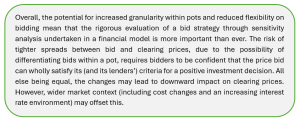
Collectively the changes increase pressure on clearing prices (the pots are more granular and there is the potential for separate clearing prices within technologies) while reducing room for error (single bids and no opportunity to rebid capacity once awarded). A material uplift between a price bid and the final clearing price is less likely and should not be relied on. This means that bidding a scrutinised and stress tested price, underpinned by robust financial modelling, is potentially more important than ever.
What this could mean for bidders
The AR8 pot structure is summarised below, highlighting which pots are subject to visibility by the Secretary of State and permitted a single bid only. All pots are subject to the potential of separate clearing prices within the pot, determined by the specific factors mentioned above.
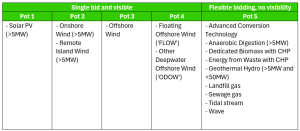
Source: UK Government Price and Pot Notice 6 July 2026, link
The flexibility for DESNZ to finalise pot budgets following review of bids above a pot’s clearing price means that additional funding will go to the projects which are viewed as best value and can be delivered in time to support the government’s Clean Power 2030 ambitions.
For bidders in pots 1 to 4, the change to a single sealed bid removes the scope for a bidding strategy which allows for varying prices based on capacity or delivery year put forward. Bidders must reach a single solution (price, capacity and delivery year) which maximises the potential of their project within this allocation round or consider holding back capacity for future allocation rounds.
This is critical as capacity which is awarded a CfD and then surrendered is now permanently blocked from bidding future allocation rounds. Seeking to realise upside by rebidding the same capacity in future CfD rounds is therefore prevented and bidding a price too low is more of an acute risk for projects. If capacity is awarded a CfD but then a downside case materialises having not been sufficiently accounted for, the project’s primary route to market could become unattractive, impairing its valuation or making it financially unviable.
The application of factor specific clearing prices, if any, under each pot will be confirmed in the Contract Budget Notice expected between September and November of this year (timing depends on applicant review/appeal scenarios). As that confirmation comes approximately two weeks before the sealed bid window opens, bidders need to proactively consider the potential implications within their bid strategy such that internal stakeholders are fully informed and ready to react as required.
For example, a developer repowering an onshore wind project may have been confident in its bid strategy as cost advantages over new greenfield projects would be expected to make the onshore wind clearing price attractive and possibly offer an upside return over its bid price. If instead pot 2 clearing prices are separated by repowering status (as indicated they could be), the repowering developer would be competing only with other repowering projects which have the same project and cost characteristics.
Likewise, for developers of large projects (in any pot) which may have expected economies of scale to make their bid competitive could instead find themselves above a project size threshold competing only with other large projects, although it is unclear if and how this will be applied.
Other developments
‘Near real time metering’ is now required for distribution connected projects from the point of meter installation. This gives LCCC better oversight of when a project begins commercial operations, thereby strengthening the ‘Unilateral Commercial Operations Notice’ (UCON) mechanism which aims to prevent generators taking advantage of high market prices before formally triggering the CfD, i.e. it removes the potential for optimising projects with a “merchant nose”. This aligns treatment of distribution and transmission connected projects and represents a further step from DESNZ to prevent ‘merchant nose’ revenues. A UCON is only enforceable once a project begins its Target Commissioning Window.
Hybrid metering, where same-technology CfD and merchant assets can share a balancing mechanism unit, is now permitted. This is a positive change for bidders, increasing flexibility to have a portion of a project on a merchant basis. As metering infrastructure and services don’t need to be replicated it reduces a drag that keeping a relatively small proportion of merchant generation would have previously added. There are a variety of restrictions including that the shared metering must be for a single technology (due to wider market rules) and not with facilities subsidised under other Government support schemes. LCCC has published further guidance on this here: LCCC Hybrid Guidance.
Real time metering reduces scope for potential upside for distribution connected projects and therefore could apply upward pressure on bid prices although this may only be minor. Hybrid metering increases flexibility on the level of capacity submitted by bidders. Both changes may impact the financial modelling scenarios that bidders consider within their strategy analysis.
How QMPF can help
QMPF supports developers, investors and lenders throughout the CfD process, including bid strategy assessment, financial modelling, lender-case analysis, project financing and transaction support. Our team has extensive experience advising renewable energy projects across onshore wind, solar PV and other low-carbon technologies.
More News…
Contacts