
Joint Ventures
Are Joint Ventures a route to unlocking private sector capital to deliver University capital projects?
Context:
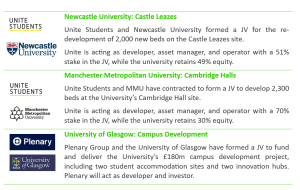
Universities have long partnered with private sector student accommodation operators through either nomination agreements to provide access to off-campus residences or Design, Build, Finance and Operate (“DBFO”) concession arrangements for on-campus accommodation. As universities seek more flexible structures to meet accommodation needs, a new phase of Joint Venture (“JV”) partnerships is accelerating. JVs between student accommodation operators and universities are starting to become more commonplace to both deliver new accommodation and refurbish existing on-campus facilities. Universities increasingly value more flexible shared-risk, shared-reward partnerships which allow them to leverage private sector capital, while also allowing investment participation and a role in the JV’s operating decisions. For developers and investors, JVs offer an opportunity to develop long-term partnerships with an anchor institution, enhanced student letting opportunities and access to prime on-campus sites. Examples of recently announced JVs include:
What are Joint Ventures and how do they differ from DBFOs?
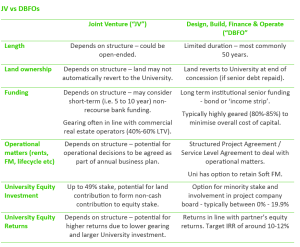
DBFOs are a well-established route for universities to deliver on-campus accommodation in partnership with private sector partners. DBFO are normally based on a concession agreement of up to 50 years and the grant of a headlease on university-owned land, which reverts to the university at maturity. DBFO projects are often highly structured to unlock very long-term senior funding (up to 85% geared, at 50-year maturities) with project agreements in place that define rent uplifts, the nomination process and manage the operational and construction risks between the partners. Due to the structured project agreements DBFO structures can be inflexible and take time to negotiate the Project Agreement ahead of Financial Close.
JVs are bespoke and there is no typical blueprint. In contrast to DBFO projects, JVs will tend to be lower-geared and less heavily “structured”, with more of the commercial operational decisions set by the JV partners through the annual business plan rather than preset by the initial project agreements. Universities considering a JV will need to explore the different structures available that will allow it to deliver core aims around rents, operational flexibility, upfront capital requirements, procurement, exit opportunities and land reversion. A JV structure may provide more flexibility to allow the University more control in operational decisions. However, it will ultimately depend on the underlying funding model selected, whether a JV structure can meet a university’s requirements and what protections would need to be in place.
Potential Opportunities:
- New residential developments – JVs can be used to deliver new accommodation projects, as an alternative to DBFOs.
- Stock transfers – as Universities deal with backlog maintenance or reimagine their current campuses, partnerships could be used to modernise or re-develop existing accommodation or convert excess academic space into bedspaces.
- Non-residential assets – JVs can also be used as a development vehicle with agreed feasibility metrics to support the development of non-residential developments.
- Financial sustainability – universities may wish to raise capital receipts from existing assets or achieve efficiencies and risk transfer through partnering with a specialist operator.
How can QMPF help?
We have experience of structuring projects, including joint ventures and “DBFOs”, leading procurement processes and providing financial advice across all project stages from initial feasibility work to reaching financial close. We can manage the commercial interface between universities and the private sector. We can assist you with:
- Financial modelling to assess project viability and potential rent strategies
- Options appraisals and business cases
- Comparing delivery options (self-build, DBFO, JV and nominations)
- ‘Soft market testing’ among providers and funders to help affirm options
- Arrangement of finance (bank facilities, development finance and income strips)
- Deal structuring and negotiation between universities and commercial partners
- Financial or lead advisor through procurement processes
- Residences portfolio financial modelling
- Support throughout university governance
We have also advised universities on the establishment of joint-ventures (with Unite, among others); and support private sector investors and operators on financial modelling, commercial structuring and raising funding for student accommodation.
Our ongoing projects comprise delivery of more than 5,000 bedspaces with clients including the University of Manchester, London School of Economics and University of Southampton.
Please get in contact if we could be of any assistance, or for a general discussion about the market and wider opportunities.
Staffordshire University Student Village – DBFO Partnership – QMPF
University of Exeter – West Park – QMPF
Manchester Metropolitan University – Student Accommodation JV – QMPF
More News…
Contacts